

Revv App Redesign
Car Rental App UX Case Study: Booking & Subscription Redesign for Revv
Overview
This UX case study covers how I redesigned Revv’s car rental & subscription app across Android and web. The goal was to simplify the booking flow, clarify subscription pricing, and reduce drop-offs for a self-drive car rental experience in India.
Revv operated two product models under one brand: short-term Rental (hourly, daily) and longer-term Subscription (15 days, 1 month, multi-month). The MVP functioned, yet it introduced friction: users struggled to understand pricing, search felt noisy, and the booking to delivery experience increased operational workload. I led the UX redesign as Lead UX Designer, collaborating closely with the Product Manager, Engineering and Ops teams to clarify product entry, streamline the multi-step booking flow, and create a repeatable component system for consistent UI across Android, iOS and web.
This project combined interaction design and product thinking. We simplified search and filtering, clarified pricing and km/fuel plans, and improved post-booking flows so customers felt confident at every step - from discovery to delivery and return.

Problem: Booking flow UX and pricing plan UX issues
No product separation
Rental and Subscription users have different goals, but the product presented them together. That created confusion at the first tap.
High cognitive load
City selection, date/time, km tiers, fuel options, deposits, promo codes and Revv Cash were surfaced too early. Users hesitated.
Weak hierarchy on the homepage
Promotional banners competed with the primary booking action, undermining discoverability of search.
Inconsistent UI across platforms
Different validations, spacing and card layouts increased implementation variance.
Post-booking opacity
Delivery windows, required documents, return rules and policies were not clear, which increased support requests.


Goal
Create clear entry points for Rental and Subscription so users choose intent fast.
Shorten time-to-booking by prioritizing search-first interactions.
Surface pricing plan details at the right time to avoid surprises.
Improve post-booking clarity to reduce support and improve customer confidence.
Introduce a pragmatic design system to ensure visual consistency and faster implementation.
My Role and Collaboration
I led end-to-end UX: discovery, information architecture, interaction design, visual design, prototyping and handoff. I worked closely with the Product Manager to prioritise scope and with Engineering and Ops to validate edge cases such as delivery windows, restricted regions and refund timelines. Implementation required tight QA on payment states and map behavior.
My UX Design Process
Collaborated for discovery and heuristic audit to document funnel drop-offs and top usability issues.
Competitive benchmarking of mobility platforms to extract proven search-first patterns.
User journeys for Rental and Subscription personas, including the post-booking touchpoints.
Mobile-first wireframes with progressive disclosure for complex pricing.
High-fidelity UI and a compact component library (cards, chips, bottom-sheets, form controls).
Handoff and release validation with annotated specs and QA checks.
UX strategy: decisions that guided the design
Separate product mental models
Present Rentals and Subscriptions as distinct paths to reduce decision friction. This immediately simplified the user’s mental map.
Search-first entry
Make city + date/time the single primary action to get users into the flow quickly.
Progressive disclosure for pricing
Show plan tiers and add-ons at PDP and booking-summary stages, not on initial search. This reduces perceived friction.
Operational clarity baked into UX
Deliverability, return location, required documents and invoice states are surfaced where they matter to avoid support escalation.
Pragmatic component system
Tokens and consistent controls eliminate cross-platform variance and speed up engineering.
Andriod and iOS App Design solutions and implementation
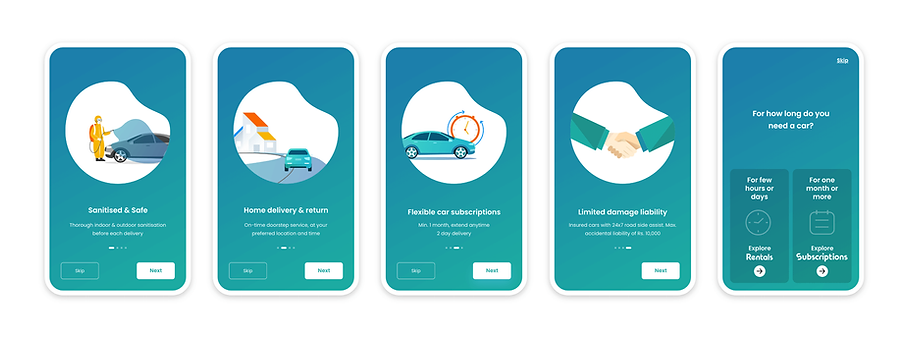
Onboarding: Setting expectations and guiding first-time users (mobile onboarding UX)
The onboarding flow introduces new users to Revv’s value proposition before they reach the rental or subscription funnels. Instead of overwhelming users with features, the onboarding emphasises trust, safety and convenience, which are the biggest decision drivers in mobility products.
Rentals flow: Selecting city, time and scanning available cars (search UX for mobility products)
The Rentals flow begins with a streamlined search model that prioritises the two decisions users make most confidently: where they want the car and when they need it. By separating city and date inputs into a clean, mobile-first pattern, the flow removes the friction that previously came from cluttered fields and overlapping promotions.
The redesigned Rentals flow reduces cognitive load at every step: from selecting the city and time to scanning available cars. By presenting information in a predictable order and keeping filters within reach, users complete their search faster and with fewer dead ends. This directly supports the booking funnel and improves decision confidence.

Car details and booking configuration — from PLP to PDP (pricing plan UX and booking configuration UX)
After selecting a city and dates, users land on the Product Listing Page (PLP), where they browse all available cars for that location. The redesigned PLP and PDP sequence focuses on clarity, comparison and progressive decision-making, ensuring that users never feel overwhelmed by pricing or configuration choices.
This redesigned sequence reduces friction between interest and commitment. By structuring decisions, enabling easy modifications, and surfacing pricing clearly, the flow increases conversion while reducing downstream customer support issues. It turns booking into a guided, confident process instead of a confusing multi-step task.

Payment and checkout: Reducing friction and building trust at the final step (payment UX optimization)
The payment flow is the final, highest-stakes step of the booking journey. Users must feel confident, protected and in control. Our redesign focused on clarity, error-proofing and progressive reassurance so customers could complete payments without frustration or confusion.
This redesign made checkout significantly more reliable and predictable. By adding progressive validation, better grouping of payment options and visible security reassurance, the flow reduced user hesitation and abandoned checkouts. It provides a sense of momentum toward completion, which is essential for any transactional mobility product.

Post-booking experience — supporting customers from confirmation to return (post-booking UX & operational alignment)
Once a customer completes the payment, the true service experience begins. Most issues in mobility rentals appear afterbooking: uncertainty about delivery time, lack of clarity around documents, confusion about refunds, or not knowing whom to contact during delays. To address this, I worked closely with the Product Manager and the Operations team to map the end-to-end operational workflow and convert it into a transparent, user-facing experience.
The redesigned post-booking flows give customers ongoing visibility into every part of their booking, from preparation to delivery to return, turning a previously opaque process into a predictable and reassuring journey.

Impact
The redesigned Revv booking ecosystem strengthened the entire rental experience end to end, improving conversion, operational efficiency and customer confidence. By clarifying product entry, simplifying search and pricing, and introducing transparent post booking states aligned with real operational workflows, the new UX reduced support dependency, lowered delivery and return failures, and created a more predictable checkout flow.
Customers gained clarity at every step from selecting a car to tracking delivery and viewing invoices while internal teams benefited from fewer disputes, fewer repetitive calls and a more consistent design system. The result was a faster, clearer and more trustworthy rental journey that supported both revenue growth and service reliability.
Want to fix drop-offs in your booking or subscription flow?
If you’re building a car rental, mobility, or subscription-based product and your users struggle with pricing, plan selection, or completing a booking, I can help. I work as a freelance UX & Product partner to redesign booking journeys, clarify subscription options, and improve conversion across mobile and web apps.